
In Patanjali’s Yoga Sutras, the sacred text of Yoga, Yoga is defined as the cessation of mental-emotional fluctuations.
This goal leads to the state of Samadhi (meditative absorption), described primarily in the first chapter (Samadhi Pada).
The exact sutra that defines Yoga is the following:
Yoga Sutra 1.2: “Yogas chitta vritti nirodhah”
Yoga: Union in God, firm concentration in the Divine, and integration into life in this consciousness.
Chitta: The mind or field of consciousness and the heart of the individual.
Vritti: The modifications, vortices, or fluctuations, the waves of thoughts and emotions.
Nirodhah: Cessation, control, or stilling.
In this view, the meaning of Yoga and Samadhi are two sides of the same coin: Yoga is both the process (the control and direction of the mind-heart) and the result (Samadhi itself).
Immediately after defining Yoga in Sutra 1.2, Patanjali describes its immediate effect:
Yoga Sutra 1.3: “Tada drastuh svarupe avasthanam”
Yoga Sutra 1.3: “Tada drastuh svarupe avasthanam,” which can be translated as:
“Then the Seer establishes himself in his True Nature.”
When the “vortices” of the mind are calmed (through the practice of yoga), individual consciousness frees itself from identifications and settles in its original, pure state: this is the state of Samadhi: a return to the True Home.
This state (Yoga = Samadhi) is only possible through meditation and maintaining a harmonious and natural lifestyle.
But what does meditation really mean?
We can say that meditation is, above all, being present, in the here and now. It means “unplugging” from the external senses and being in perfect memory of the Supreme Self. This conscious experience allows us to realize that we are observers of ourselves, of others, and of all life itself. Meditation is coming into contact with the inner self (small self and the Higher Self), discovering that everything we see outside is actually a profound reflection of what dwells within.
There are many forms, techniques, and ways to meditate. However, what I feel is most true and powerful is stopping completely in inner silence. Paramahansa Yogananda, my beloved Gurudeva of Kriya Yoga, says: “Silence is the altar of the Spirit.” This means that silence is the true nourishment of the soul. Only in complete stillness can we clearly see everything within us, and it is in total stillness that we can fully listen to the Divine voice, in our heart, in the Self.
It’s wonderful to contemplate a sunset, observe a flower about to bloom, listen to the sound of birds, and see a dog or a child running and playing… Being in a state of reflection and full attention aids and complements the act of meditation, but it is not in itself: “meditating.” In my humble opinion, meditation is, as Patanjali says, Samadhi, or total and complete immersion beyond the senses, in superconsciousness (turyia).
In Kriya Yoga, when one meditates, one enters the spiritual eye, penetrating it. Entering the state of total absorption takes a certain amount of time, and it requires immense courage and willpower to focus so deeply that one pierces the cosmic illusions or the so-called “veil of maya.” At the same time, this meditative act occurs without any tension; rather, it occurs only in complete and total relaxation and abandonment; combined with firm concentration, without distractions and without any other external action. In true meditation, the only action is to connect with God, with the Guru, with the Mother, with the Father, with the Self, with the essence of life that begins (Brahma), sustains (Vishnu), and dissolves all (Shiva)—or whatever you wish to call It.
This type of meditation, as described in the previous paragraph, is for souls who have already “played” enough in this ¨dance of duality¨ (also called lila) and who finally want to liberate themselves (moksha) and return to the True Home. It is important to note that such beings are not indifferent to external life; on the contrary, they are usually deeply sensitive and full of compassion for all the suffering and pain in the world. The yogi-yogini carries out his or her task and service in the world, to the best of his or her ability, with the aim of contributing to greater beauty, lightness, fluidity, and external harmony; but he or she understands that the true, safe path is to root oneself in the Divine, knowing that we are all waves that then return to the same Cosmic Ocean.
DO YOU WANT TO LEARN TO MEDITATE AND PRACTICE YOGA ON AND OFF THE MAT? I’M HERE FOR YOU.
Come with me, Sunday, June 21st, to celebrate together the Yoga Day.
I’ll be offering a special online meditation for you, with a free donation.
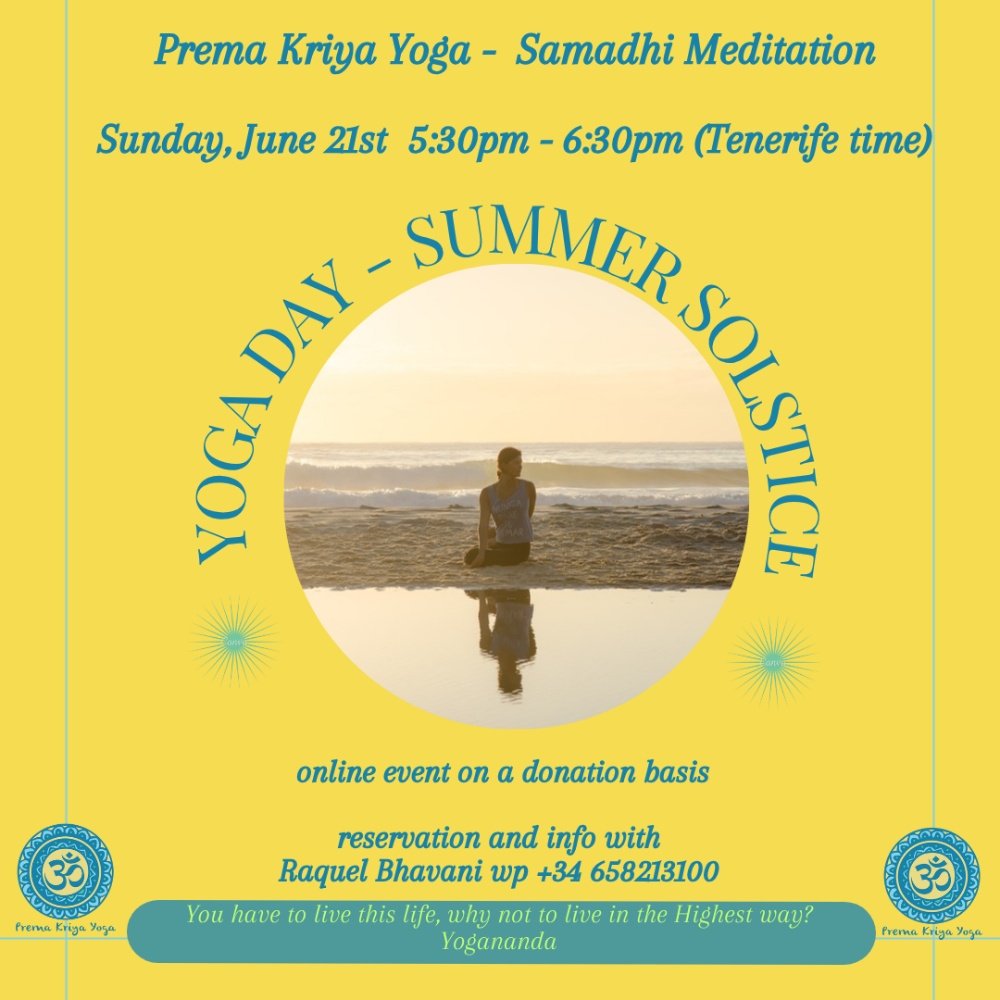
For those interested in private sessions or to register and receive more information about practices, workshops, retreats, and courses, message me directly on WhatsApp at +34 658213100
Namaste
Jay Guru Jay
Raquel Bhavani
www.premakriyayoga.com
¨To be dominated by moods means to belong to the material world.
If you firmly resolve to never lose
peace, you will reach a divine state.Create a secret refuge of silence within yourself, where you will not allow bad moods, suffering,
conflicts, or disharmonies to enter.Leave out hatred, vengeful spirits
and desires. In this refuge of peace, God will come to you.¨
Paramahansa Yogananda
Self-Realization Fellowship Lessons